Enabling RFID-Based Vehicle Tracking with Mobile Operations for Toyota Finance
Executive Summary
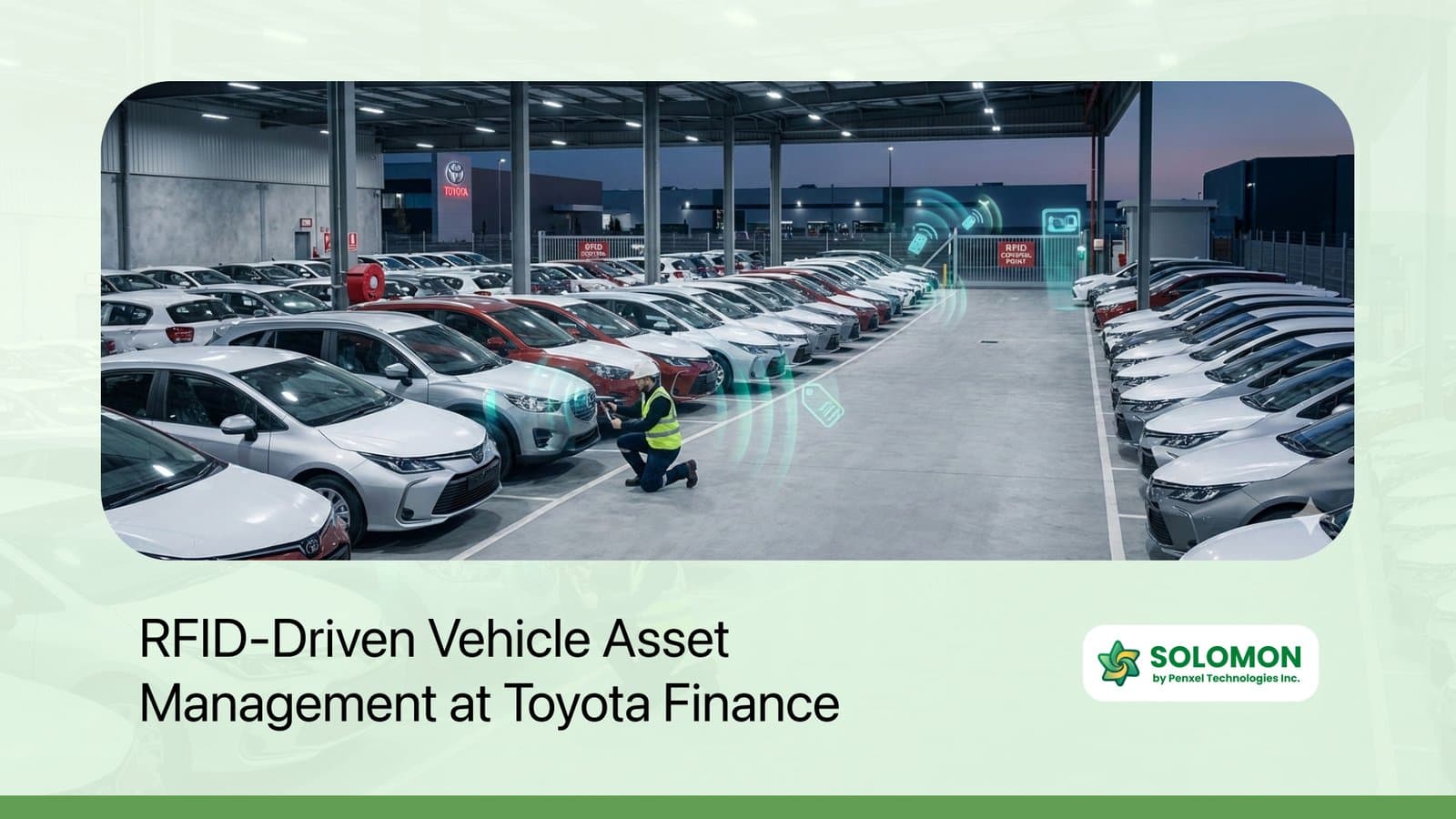
Toyota Finance implemented a centralized Asset Management System enhanced with mobile operations and RFID technology to gain real-time visibility over vehicle assets stored in warehouses and vehicle yards. The primary objective was to ensure that every vehicle movement—especially outbound releases—is automatically detected and reflected in the system without relying on manual confirmation.
Rather than replacing existing warehouse systems, the solution focused on accurately tracking vehicle assets and synchronizing their status through RFID-enabled detection and mobile workflows.

The Challenge
Toyota Finance manages a large and continuously moving fleet of vehicle assets. Prior to the solution, several operational gaps existed:
- Asset movement was confirmed manually, increasing the risk of missed or delayed updates.
- There was no automatic detection when vehicles exited warehouse facilities.
- RFID tagging was not standardized or system-controlled.
- Field personnel relied on fragmented tools for asset validation.
- Asset records could fall out of sync with actual vehicle locations.
Given the value and volume of vehicles involved, Toyota Finance needed a reliable, automated, and mobile-first asset tracking approach.
The Solution

The project delivered a vehicle-focused Asset Management System, supported by a mobile application and RFID infrastructure, designed specifically for warehouse and yard environments.
1. Centralized Asset Management System
The Asset Management System serves as the primary platform for vehicle asset control. It enables Toyota Finance to:
- Register vehicles as tracked assets.
- Maintain up-to-date asset status across storage, movement, and release stages.
- Ensure each vehicle is uniquely identifiable through RFID tags.
- Provide a single source of truth for vehicle inventory.
The system prioritizes asset accuracy and real-time status visibility rather than warehouse process execution.
2. RFID-Based Asset Tracking
RFID technology is used to automate the detection of vehicle movement.
Key capabilities include:
- RFID readers installed at warehouse and yard exit points.
- Automatic detection when a vehicle is released from storage.
- Immediate asset status updates without manual scanning.
- Reduced dependency on human intervention for asset movement confirmation.
Once a tagged vehicle passes through an RFID reader, the system automatically recognizes the event and records it.
3. Mobile Application for Asset Operations
A mobile application supports operational staff in handling vehicle assets on-site.
Mobile functionality includes:
- RFID verification during asset handling.
- Guided steps for receiving, tagging, and releasing vehicles.
- Offline capability for areas with limited connectivity.
- Photo and condition capture for documentation and audit purposes.
The mobile app ensures that field operations remain efficient and consistent with system records.
4. RFID Tag Generation and Assignment
RFID tag creation is driven by vehicle data:
- Vehicle information originates from the Vehicle Management System.
- The Asset Management System generates RFID tags based on this data.
- Tags are printed and encoded before vehicles are parked.
- RFID tags are physically attached to vehicles prior to storage.
This ensures that all vehicles entering the warehouse are immediately trackable.
Business Impact
The solution delivered measurable value to Toyota Finance:
Enhanced Asset Visibility
- Real-time awareness of which vehicles are inside or outside storage facilities.
- Reduced discrepancies between physical vehicles and asset records.
Operational Efficiency
- Faster vehicle release processes.
- Less reliance on manual logs and confirmations.
Risk Reduction
- Improved control over high-value assets.
- Automatic audit trails for asset movement events.
Scalable Foundation
- RFID infrastructure supports future expansion without reworking core systems.
Key Takeaways
- Asset-centric design is critical when warehouses already have existing systems.
- RFID enables passive, reliable detection for large assets like vehicles.
- Mobile tools bridge the gap between physical operations and digital records.
- Automation significantly reduces operational risk.
Strategic Value and Long-Term Readiness

The Asset Management System establishes a strong operational foundation for Toyota Finance by ensuring that vehicle movement is accurately captured, verified, and reflected in real time. By combining RFID automation with mobile-driven field operations, the platform supports current business needs while remaining adaptable to evolving operational requirements.
Key long-term strengths include:
- A standardized asset tracking approach that can be consistently applied across different storage locations.
- Improved decision-making through reliable, system-verified asset data.
- Reduced operational risk by minimizing dependency on manual confirmation.
- A scalable framework capable of supporting increased vehicle volumes without added complexity.
This positions Toyota Finance with a future-ready asset control capability that strengthens governance, improves efficiency, and supports continued growth without disrupting existing warehouse operations.